What is a tackle? An Important Defensive Technique in Football
Football is exciting not only because of its goals but also because of precise defensive plays. For new fans, what is a tackle is often a big question when they see a defender rush in to win the ball.
Understanding this technique helps distinguish a legal challenge from a foul and assess a player’s ability to read the game.
When you coi trực tiếp bóng đá, you can also better understand why many defenders rarely slide tackle yet still excel at defending.
What is a tackle in football?
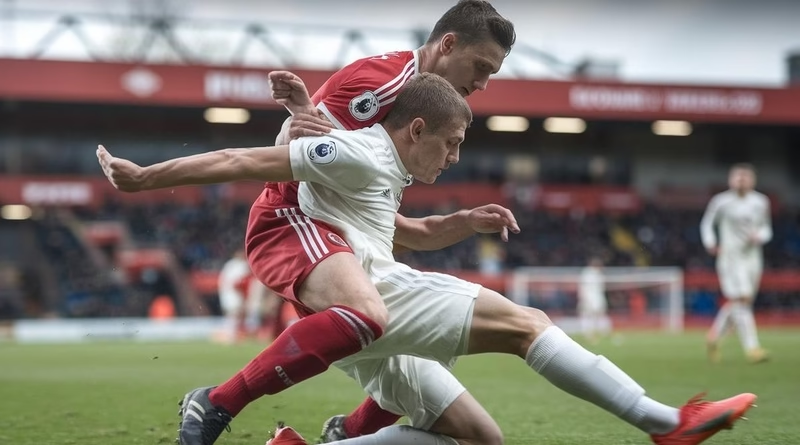
Simply put, what is a tackle refers to a defensive technique in which a player uses their feet to win the ball or force an opponent to lose control of it.
In English, this action is commonly called a tackle. A good tackle requires the player to observe the ball’s direction, the opponent’s speed, and the distance between them.
A tackle can be made while a player is standing or sliding along the pitch. The aim is to play the ball at the right moment while controlling the force used.
Law 12 of the IFAB Laws of the Game states that a tackle or challenge can be penalized if it is made carelessly, recklessly, or with excessive force; the severity of the offence determines the disciplinary action.
When watching on Vaoroi, fans should not judge a challenge solely by whether the defender touched the ball first.
The referee also considers the direction of the challenge, its speed, the point of contact, and the risk of injury. Therefore, understanding this technique helps viewers assess refereeing decisions more objectively.
Common types of tackles
After learning what is a tackle, viewers can distinguish three common types. A standing tackle is made while the player remains on their feet.
The defender closes down the opponent, waits for them to push the ball away from their feet, and then blocks or pokes it away. This approach is safer because the defender maintains their balance.
A sliding tackle involves a player lowering their centre of gravity and sliding towards the ball with one leg extended.
This technique is useful in urgent situations but carries greater risks. Being a fraction of a second too late can turn the challenge into a free kick, penalty, or booking.
A poke tackle is a technique in which a defender uses the toe of their boot to poke the ball out of an opponent’s control.
In high-pressing matches on Vaoroi TV, this type of intervention frequently occurs in midfield and along the flanks.
Good defenders do not necessarily need to make frequent sliding tackles. They prioritize maintaining their position, forcing opponents into unfavourable areas, and then stepping in at the right moment.
A deeper understanding of tackling shows that defensive quality depends on timing and anticipation.
When is a tackle considered a foul?
Not every challenge is automatically legal just because the player touches the ball first. This is an important point when learning what is a tackle.
The referee considers the direction of the challenge, the player’s ability to control their body, the intensity of the contact, and the risk posed to the opponent.
According to the IFAB, a tackle involving excessive force or endangering an opponent can be considered serious foul play and result in a red card.
If a player challenges carelessly, the opponent may be awarded a direct free kick, even if the offender does not necessarily receive a card.
If the challenge is reckless, the player must be cautioned. If excessive force is used or the opponent’s safety is seriously endangered, the player may be sent off.
When watching coi trực tiếp bóng đá on Vào Rồi TV, viewers should watch slow-motion replays to see whether the player’s foot is directed toward the ball or the opponent’s ankle or shin. However, the refereeing team always makes the final decision.
Some fans also follow tỷ lệ kèo, but understanding the rules is the foundation for analysing a match’s technical aspects.
Knowing what is a tackle helps viewers assess defensive challenges based on clear criteria rather than emotions.
How to tackle effectively and safely
To tackle effectively, players need to maintain an appropriate distance from the opponent in possession.
Diving in too early gives the opponent an opportunity to change direction, while waiting too long opens up space. Therefore, the key factor when learning what is a tackle is not strength but timing.
Defenders should observe the opponent’s preferred foot, dribbling speed, and body orientation. When the ball moves away from the attacking player’s feet, it is often the right moment to intervene.
For a standing tackle, the player should keep their centre of gravity low, maintain a firm supporting foot, and block the ball.
For a sliding tackle, they need to identify the ball’s path, slide safely, and avoid leading with the studs towards the opponent.
Winning the ball does not mean the job is finished. The player needs to get back up, shield the ball, pass it, or launch a counterattack.
Top-class defenders do more than simply clear the ball; they turn defensive actions into opportunities to gain control.
Following Vaoroi Link helps viewers observe how defenders choose the right moment to intervene.
Once you understand tackling, you will see that an effective challenge requires technique, composure, and discipline.
The role of tackling in modern tactics
In modern football, tackling is not merely an action to win the ball back; it is also part of pressing systems, transitions, and space protection.
Defensive midfielders can tackle to stop counterattacks, full-backs can block routes down the wings, and centre-backs can intervene when strikers approach dangerous areas.
Teams that press high place great importance on winning the ball back quickly after losing possession. An accurate tackle helps maintain pressure.
Conversely, in a low defensive block, players need to remain patient because challenging at the wrong moment can open up space in front of goal.
On VaoroiTV, viewers can combine tackle counts with where they occur to understand each player’s role.
A high tackle count doesn’t necessarily indicate excellent defending; sometimes, players who make fewer tackles read the game better and force opponents to pass backwards.
Even when following tỷ lệ kèo, fans should keep that information separate from their assessment of technical performance.
Essentially, understanding what is a tackle helps viewers appreciate football on a deeper level, from the moment a defender waits patiently to the instant they decide to intervene.
Conclusion
In summary, understanding what is a tackle is fundamental to appreciating the art of defending. This technique requires anticipation, timing, and the ability to control force.
When watching matches on digital platforms, viewers can focus on how defenders maintain their positions and choose the right moment to intervene.
A well-executed tackle can prevent a goal, initiate a counterattack, and change the course of a match.