
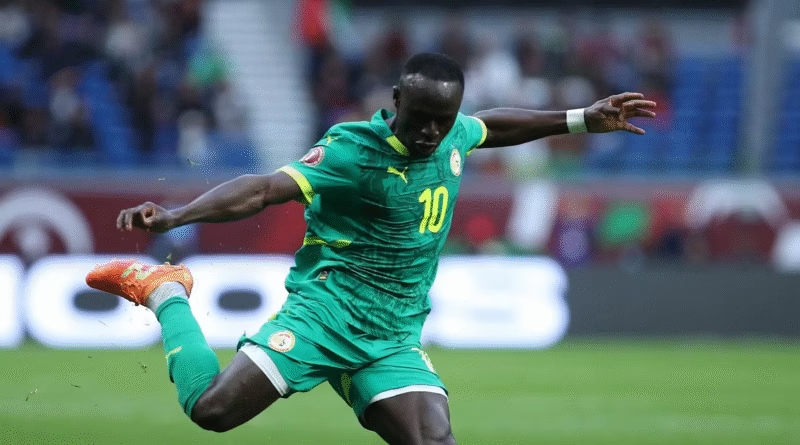
Sadio Mané For South African Readers: Leadership, Mobility And The Human Side Of African Greatness
South African football has always understood the value of a forward who does more than score.
From Bafana Bafana’s eras of wide runners, pressing forwards, and selfless creators, local readers know attacking greatness is often built in the spaces between the obvious moments. Sadio Mané’s biography belongs in that category.
His story reaches South Africa through several doors: the 2018 World Cup qualification race, the wider CAF rivalry map, and the shared African debate about what leadership should look like when a star carries a national shirt.
For adult fans who track fixtures, player form and match context across digital platforms, accessing the hollywoodbets login can be part of the broader online match-day experience, alongside checking lineups, injury updates and live scores.
The football question remains more important: why has Mané’s career stayed so readable for African audiences outside Senegal?
The answer is not only talent. It is movement, restraint, durability and a public identity built around responsibility.
For South African readers, Mané’s career offers a useful case study in how an African footballer can become global without losing the local meaning of his journey.
Why Mané Still Matters to South African Readers
South Africa and Senegal have crossed paths in moments that changed more than one table. In November 2017, Senegal’s win in Polokwane secured their return to the FIFA World Cup, and Mané’s role in that match was not decorative. His direct running and incisive passing helped turn pressure into qualification.
For Bafana Bafana supporters, that result still sits inside a larger memory of missed margins, administrative twists and continental frustration.
Yet it also shows why Mané is worth studying beyond Senegalese pride. He was not just a famous name passing through South Africa. He was a decisive actor in a match where composure mattered as much as speed.
That is the first useful lesson from his biography: great African forwards often shape games before the final shot.
Mané could receive wide, drive inside, press the ball carrier, and create panic without needing every move to end with his own finish.
In South African football terms, that kind of forward is valuable because he changes the rhythm of the opponent’s defence.
From Bambali to the Big Stage
Mané’s origin story has been told often, but it matters because it sets the tone for his career. He came from Bambali in southern Senegal, far from the polished academy image that many European audiences associate with modern stars. His route carried risk, family tension, and uncertainty before it became a professional pathway.
The early European steps were not glamorous in the beginning. Metz gave him a professional start, Red Bull Salzburg helped sharpen his output, Southampton placed him in the Premier League, and Liverpool turned him into one of the defining African players of his generation.
The pattern matters: each stage added a layer rather than replacing the previous one.
For South African readers, this progression feels familiar. Many local talents also move through uneven systems, late exposure, and pressure to adapt quickly. Mané’s biography is therefore not just a success story.
It reminds us that African development is rarely linear, even for players who later look inevitable.
| Career phase | What changed in Mané’s game | South African reading of the phase |
| Bambali and early Senegal years | Hunger, resilience and self-belief formed early | Talent often begins outside formal visibility |
| Metz and Salzburg | Direct pace became professional efficiency | Structure can turn raw speed into repeatable impact |
| Southampton | Premier League intensity tested decision-making | Adaptation matters as much as reputation |
| Liverpool | Pressing, finishing and combination play reached elite level | African forwards can lead without being isolated stars |
| Senegal with AFCON success | National responsibility became part of his legacy | Continental greatness is judged by shared achievement |
Leadership Without Theatre
Some footballers perform leadership loudly. Mané’s version has often looked quieter. He leads through work rate, recovery runs, intelligent pressing and the willingness to accept different attacking roles.
That matters because African national teams often need stars who can lower the temperature rather than raise it.
At Liverpool, Mané played in a front line where ego could easily have become a problem.
Instead, the balance with Mohamed Salah and Roberto Firmino became one of the great attacking references of the modern Premier League era. Mané scored, pressed, created space and accepted tactical work that did not always appear in highlight packages.
This is where South African football can read his career in practical terms. Bafana Bafana’s strongest moments have usually come when the team balance is clear, not when one player is forced to carry the entire emotional load.
Mané’s example shows that a star can be central without making every attack about himself.
Several traits explain that leadership style:
- Repeatable intensity: Mané’s pressing was not occasional decoration. It was part of his value.
- Role flexibility: He could attack from wide zones, combine centrally, and stretch a back line.
- Tournament nerve: His Senegal career included painful exits before the AFCON breakthrough.
- Public restraint: His image rarely depended on noise, which made the football feel more convincing.
- Community connection: His roots remained part of his story, not a detail polished away by fame.
The AFCON Penalty That Reframed His Legacy
Mané’s decisive penalty in the 2021 Africa Cup of Nations final did more than win a trophy. It changed the way his international career could be discussed.
Senegal had carried the burden of near-misses, including previous final defeats, and the national team needed a moment that ended the waiting.
The drama was sharper because Mané had missed an earlier penalty in the same final. Many players would shrink after that.
He stayed present, took responsibility again in the shootout, and delivered the kick that gave Senegal their first AFCON title. That is the kind of detail that makes biography richer than a trophy list.
For South African readers, there is a broader lesson here. Continental football is full of players whose reputations turn on single moments, sometimes fairly and sometimes cruelly.
Mané’s final showed that legacy is not built by avoiding failure. It is built by returning to the ball after failure has already become visible.
What Young African Players Can Learn From Mané
Mané’s career is useful because it does not ask young players to copy his exact path. Very few can.
What they can copy is the logic behind the path: improve the details, keep the game simple when pressure rises, and make movement a habit rather than a reaction.
For a South African academy player, his story offers a clear message. Speed alone is not enough. European clubs, national coaches and major tournament opponents quickly learn how to defend against straight-line pace.
Mané became elite because his speed was tied to timing, body shape, pressing decisions and finishing variety.
There is also a mental lesson. Mané’s career includes risk, rejection, adjustment, and public pressure. The glamour arrived late.
The discipline had to arrive early. That is why his biography still feels useful in South Africa, where the gap between raw talent and stable professional opportunity can be difficult to cross.
The Human Side of African Greatness
Mané’s public image has often been linked to humility and community responsibility.
Those themes can become clichés if handled lazily, but in his case they help explain why many African fans see him differently from a typical global celebrity footballer. He represents success that still points back toward a place.
That matters across the continent. South African supporters may not share Senegal’s national emotion, but they understand the idea of a player carrying family, town and country into every major stage.
African football biographies are rarely individual in the narrow sense. They are usually collective stories told through one body.
In the end, Mané’s greatness is not only that he won major trophies or played for historic clubs. It is that his career can be read from several angles at once: tactical, emotional, social and continental.
For South African readers, that makes him more than an opposing star from a past qualifier. It makes him a reference point for what African excellence can look like when speed, sacrifice and responsibility move together.


