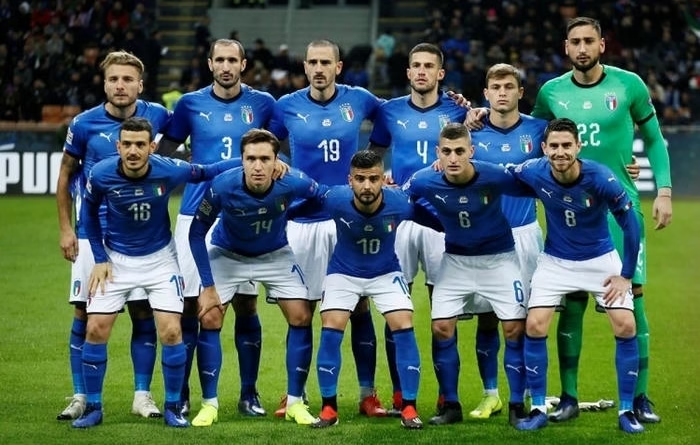
Italy Struggle Against Luxembourg Raises Concerns For Azzurri Rebuild
In the world of modern football analysis, discussions around kèo nhà cái often intensify whenever major national teams unexpectedly struggle against weaker opponents.
The recent international friendly between Italy and Luxembourg during the June 2026 FIFA Days has become one of those talking points.
Despite being widely considered superior in every aspect of the game, the Italian national team could only secure a narrow 1-0 victory, leaving fans questioning the effectiveness of their ongoing rebuilding process and long-term direction.
The difficult transition phase of Italian football after the 2026 World Cup failure
The failure of Italy to qualify for the 2026 FIFA World Cup marked a significant setback for one of football’s most historic nations.
For a country with four World Cup titles and a deeply rooted football identity, missing the tournament was not just a sporting disappointment but also a symbolic crisis.
In response, the Italian Football Federation initiated a full-scale restructuring process.
A transitional coaching setup led by interim manager Silvio Baldini was tasked with rebuilding the squad around younger talent, prioritizing long-term development over immediate results.
The focus has now shifted toward future competitions such as the UEFA Nations League and the Euro 2028 qualification campaign.
However, rebuilding a national team is never a smooth process. Young players often lack international experience, tactical maturity, and the psychological resilience required at the highest level.
This transitional gap has become increasingly visible in recent performances.
Italy vs Luxembourg: a match that exposed deeper issues
On paper, Italy were overwhelming favorites against Luxembourg. The opposition is traditionally considered a lower-tier European side, with limited success in international competitions. Yet football is never decided on paper.
From the opening whistle, Italy dominated possession, controlled midfield tempo, and pushed Luxembourg deep into their defensive half.
Despite territorial superiority and numerous attacking sequences, Italy struggled to convert its dominance into goals.
The final scoreline of 1-0 may appear acceptable, but the performance revealed several structural weaknesses that cannot be ignored.
Lack of attacking efficiency remains Italy’s biggest problem
One of the most concerning aspects of the match was Italy’s inability to finish scoring opportunities. The attacking unit, composed largely of young and inexperienced players, created multiple chances but failed to capitalize.
Shots were often rushed, poorly placed, or lacked sufficient power to trouble the goalkeeper. In modern elite football, dominance in possession means little without clinical finishing ability.
Italy’s lack of sharpness in the final third remains a critical issue that the coaching staff must urgently address.
The problem is not just technical but also psychological. Young forwards often hesitate in decisive moments, preferring safe decisions to calculated risks.
This hesitation slows down attacking momentum and allows defensive teams to regroup.
Weak cohesion between midfield and attack
Another major issue highlighted during the match was the lack of fluid connection between midfield and forward lines.
Italy’s buildup play frequently broke down in the final third due to inaccurate passing, poor timing of runs, and miscommunication between players.
The introduction of several young talents simultaneously has resulted in a lack of established chemistry. While this is understandable in a rebuilding phase, it significantly affects overall tactical efficiency.
Midfielders struggled to consistently supply forwards with quality through balls, while attackers often made runs that were not synchronized with the tempo of the play.
This disconnect prevented Italy from converting possession into meaningful scoring opportunities.
Defensive instability despite a clean sheet
Although Italy managed to keep a clean sheet, their defensive performance was far from flawless. Luxembourg managed several dangerous counterattacks that exposed gaps in Italy’s defensive structure.
Goalkeeper Gianluigi Donnarumma once again proved his importance with crucial saves that preserved the lead. His leadership and experience remain vital in stabilizing a relatively young squad.
However, the backline occasionally lost concentration, particularly during quick transitions. In matches against stronger opponents, such lapses could prove costly.
Defensive organization, especially during counterattacks, remains an area that requires refinement.
Luxembourg’s disciplined approach made the difference in competitiveness
Luxembourg may not be a traditional football powerhouse, but their tactical discipline and fighting spirit made them a difficult opponent.
They adopted a compact defensive structure, maintaining tight spacing between lines and minimizing gaps for Italy to exploit. Their organized shape forced Italy to play wide and prevented penetration into the center.
When in possession, Luxembourg relied on quick transitions and direct counterattacks.
These moments often unsettled Italy’s defense and demonstrated that even smaller football nations are becoming increasingly competitive on the international stage.
The match highlighted a growing trend in global football: tactical organization and collective discipline can significantly reduce the gap between strong and weaker teams.
Positive signs from Italy’s young generation
Despite the disappointing performance, there were still encouraging signs for Italy’s future.
The match-winning moment came from Esposito, who scored with a well-timed header. His movement inside the box and ability to find space demonstrated natural attacking instincts that Italy desperately needs.
If developed properly, he could become a key figure in the national team’s future attacking system.
Beyond individual performances, the younger players showed commitment, energy, and willingness to follow tactical instructions.
While mistakes were frequent, their attitude and effort suggest a strong foundation for future development.
Donnarumma also continued to provide stability, acting as both a last line of defense and a vocal leader organizing the team during difficult phases of play.
Tactical evolution and future challenges
Looking ahead, Italy must address several key areas if they want to return to the elite level of international football.
Improving goal-scoring efficiency
The most urgent issue remains finishing. Italy must develop forwards capable of converting limited chances into goals. Training must focus on composure, decision-making, and finishing under pressure.
Building team chemistry
Frequent rotation and experimentation have prevented the formation of a stable starting eleven. More consistent selections will be necessary to develop understanding between players.
Creating a modern football identity
Historically, Italy was known for defensive solidity and tactical discipline. However, modern football demands a more dynamic and flexible approach.
The team must evolve into a system that balances defensive stability with creative attacking play.
The long road toward rebuilding success
The narrow victory against Luxembourg is both a warning and a learning opportunity. While the result avoided embarrassment, the performance revealed that Italy’s rebuilding process is still in its early stages.
Patience will be essential. Not every generation of players can produce immediate success, and the current squad requires time to develop cohesion and experience.
If managed correctly, this transitional phase could eventually produce a stronger, more balanced team capable of competing with Europe’s elite once again.
In the meantime, fans continue to follow international football closely, alongside discussions about match predictions and betting trends commonly associated with keo nha cai analysis.
For those interested in football odds, predictions, and match insights, platforms such as https://keonhacai55.de/ remain frequently referenced within the football community.
Conclusion
Italy’s narrow 1-0 win over Luxembourg may look like a routine result on paper, but the performance tells a deeper story.
The Azzurri are clearly in a transitional phase, struggling with attacking inefficiency, lack of cohesion, and defensive inconsistencies.
At the same time, the emergence of young talents and the leadership of experienced figures like Donnarumma offer hope for the future. The rebuilding process is far from complete, but it is underway.
If Italy can address its weaknesses and maintain a clear long-term vision, it still has the potential to re-establish itself among Europe’s elite in the coming years.