
European Clubs Under Growing Pressure From The International Game

Football has always worked alongside international breaks. They have been part of the structure for decades. What has changed is how heavily they now cut into the season, and how quickly clubs feel the impact once players return.
FIFA are also changing the format again in 2026. The separate September and October breaks are being merged into one longer autumn window, alongside the usual breaks in March, June and November.
The aim is to reduce the number of early-season interruptions. In practice, it creates longer absences at once.
Clubs are still working through what that means for preparation, recovery and squad management.
This write-up, produced in partnership with Tribuna.com, looks at how the growing demands of international football are increasingly shaping the club season across Europe.
What international duty does to club football
The effects tend to follow a familiar pattern across top teams.
| Factor | What happens | What it looks like in matches |
| Match load | Players return after two competitive internationals, often in high-stakes fixtures | Teams look short of rhythm in the early phases of games |
| Travel | Long-distance travel across continents in short recovery windows | Slower recovery across the squad, uneven sharpness |
| Injuries | Muscle problems, knocks, and the occasional longer-term setback picked up on duty | Unexpected absences or players not fully fit on return |
| Training disruption | Key players miss several sessions during international weeks | Less cohesion in pressing and build-up patterns |
| Return timing | Players come back on staggered schedules across the week | Managers forced into late selection calls |
The impact builds across weeks, especially during busy parts of the season, and examples from the ongoing season show that clearly.
2025-26: disruption without warning
This season has already produced clear examples across Europe.
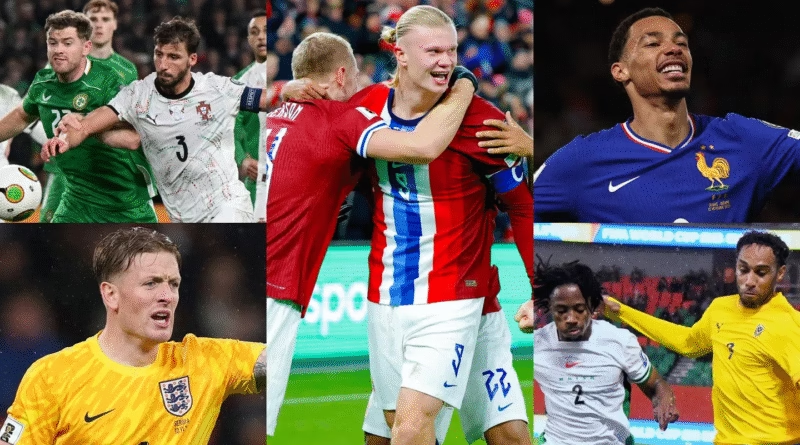
- At PSG, Khvicha Kvaratskhelia returned from Georgia duty in October after heavy minutes and struggled for sharpness in a Ligue 1 match that followed. Vitinha came back later than expected from Portugal’s fixtures and went straight into a packed schedule without a proper training block.
- Manchester City’s Erling Haaland picked up a minor issue while on Norway duty in September. He was not ruled out long-term, but Pep Guardiola still adjusted his forward rotation in the following Premier League games.
- Arsenal’s Declan Rice returned from England duty in October with limited preparation time before a league match that required early in-game management. Martin Ødegaard also returned from international duty with Norway shortly after, reducing his involvement in full training sessions that week.
- Jude Bellingham returned from England duty in November and was eased back into Real Madrid’s La Liga campaign, with controlled minutes across the next fixtures.
Arsene Wenger’s proposal and why it sits in the background
Former Arsenal manager Arsene Wenger put forward a different idea in 2021 while serving as FIFA’s Chief of Global Football Development, having already left his long spell as Arsenal manager.
His proposal was simple in concept. Reduce the number of international breaks and group fixtures into fewer, longer blocks across the season. The aim was to stop the constant interruption of club football and give teams longer, uninterrupted periods to work.
It never moved beyond discussion. FIFA and UEFA did not adopt it, and clubs were never convinced by the trade-off. The concern was straightforward.
Fewer breaks would mean longer absences at once, and less flexibility if injuries or fatigue issues appeared during those windows. The idea faded, but the problem it tried to address remained.
The 2026 calendar change and what it actually does
The solution now arriving takes a different direction. The next version of the international calendar removes the separation between September and October breaks. They are being merged into a single extended autumn window, with the rest of the international structure remaining in place.
The balance changes not just because one break is removed from the calendar. It changes because international football is concentrated into a larger block.
This happens at the exact point in the season when clubs are still building rhythm, fitness, and tactical cohesion — a trend that analysts at betting-insider have also highlighted in their analysis of how fixture congestion affects team performance.
For top European teams, the concern is less about the number of matches and more about how compressed they are.
A player in two qualifiers for a South American or African national team could now spend close to two weeks away from club training in one stretch, with extensive travel included. Managers worry about physical tiredness and the tactical disconnect that follows.
This problem becomes more acute for clubs competing in many competitions. By late autumn, Champions League matches, domestic title races, and early knockout rounds start to overlap. One poorly timed injury during a long international window can change an entire month of a season.
The scepticism inside clubs is not difficult to understand. FIFA argues the new structure reduces interruptions, but the overall match volume remains unchanged.
Instead, the calendar packs four international fixtures into a single extended autumn block, increasing the risk of fatigue, disrupted training cycles, and late returns from long-haul travel.
European Leagues and FIFPRO have already described the wider international calendar as “unsustainable” in formal complaints against FIFA.
Coaches often prefer shorter interruptions because they allow for more careful management of injured or overloaded players. Longer windows offer less flexibility.
That tension exists within the modern football calendar now. International football has commercial power and political immunity, but clubs increasingly feel they bear the physical consequences once the season restarts.


